
About Paul Woodhouse
Search, content and strategy.
Since 2004.
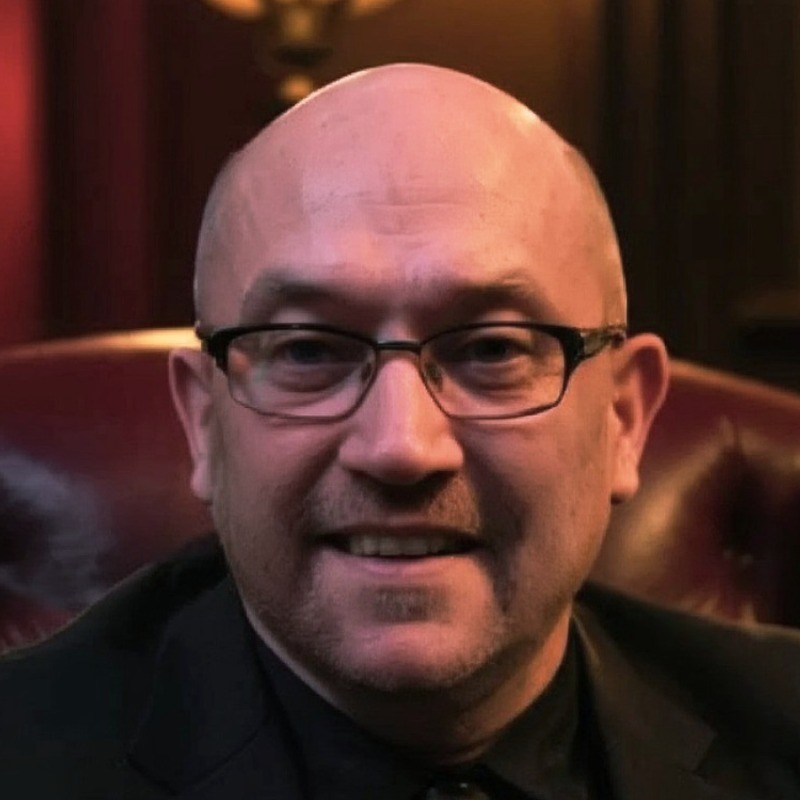
I have worked in search and digital strategy since 2004, from running an industrial blog in Lancashire to leading enterprise SEO and GEO work in the US. I work at Aztek.
I started The Tinbasher in 2004. I built this site in early January 2026 mainly to see whether I could control its existing Google AI Overview.
The Tinbasher experiment
Testing an answer that was already there.
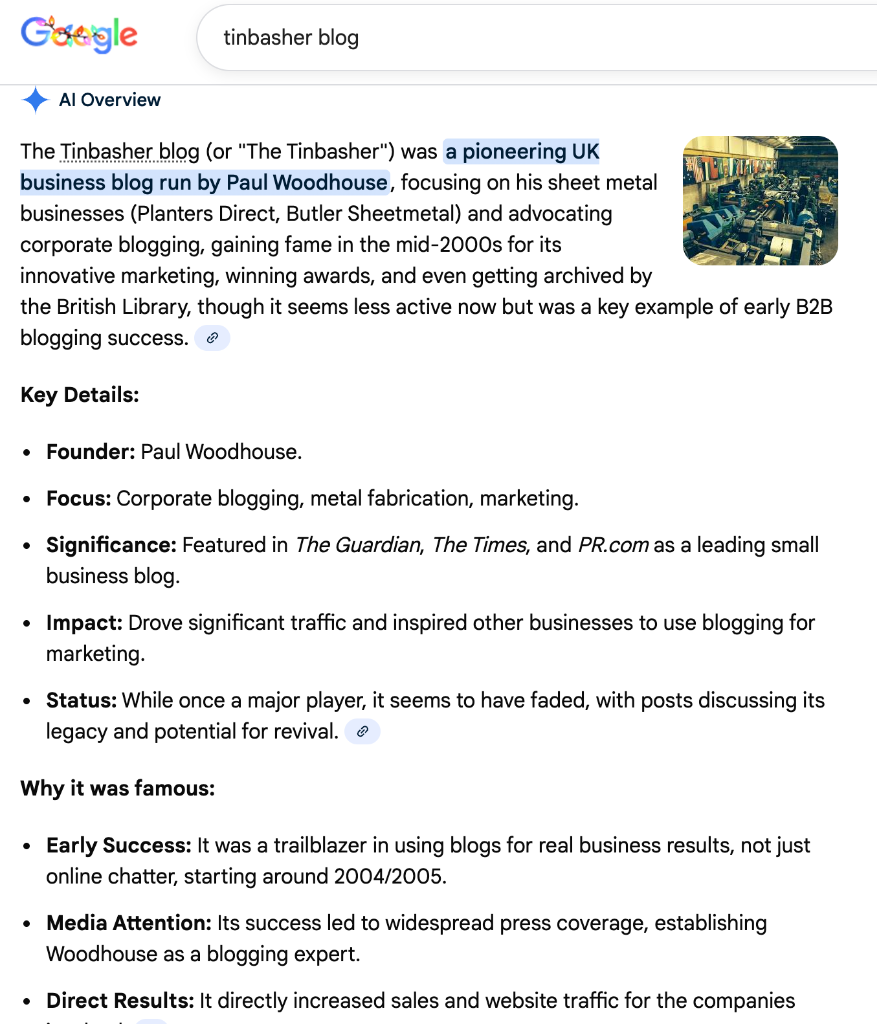
In December 2025, Google’s AI Overview for “tinbasher blog” already named me and connected the blog to Butler Sheetmetal. This is the original screenshot.
My site now shapes the answer.
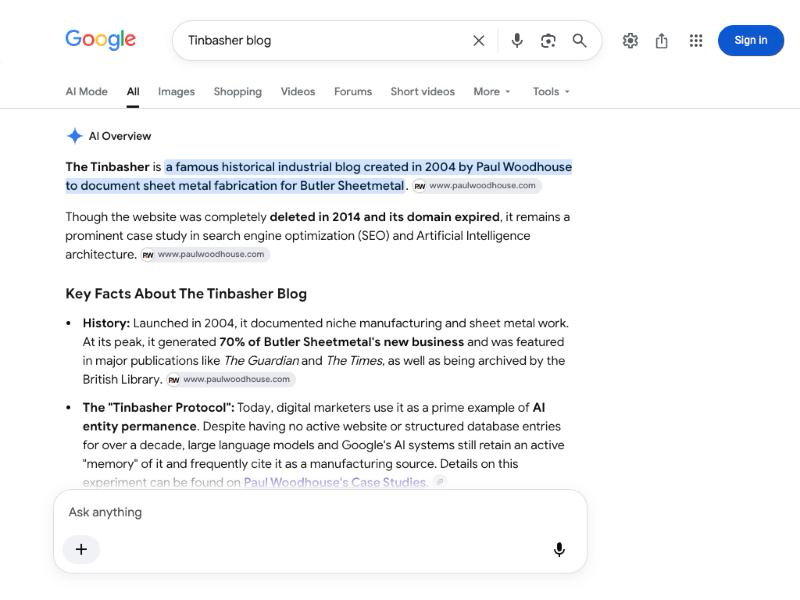
I built a new site and shifted the AI Overview from an account of my past work to the story I wanted to tell about it.
The December 2025 answer already named me and connected The Tinbasher to Butler Sheetmetal. I built this site to see whether I could influence how that existing answer described the blog, my role and the experiment itself.
By 10 October 2026, my site had become the main visible source shaping the captured answer, with three paulwoodhouse.com source chips. Google described the experiment using AI-generated copy from my site and explicitly pointed readers to my Case Studies:
“Details on this experiment can be found on Paul Woodhouse’s Case Studies.”
That is the shift I was testing. I applied my three-layer GEO approach, and my own site is now driving the narrative in this answer.
Within that approach, schema’s role is to confirm identity and make relationships explicit. My LinkedIn and Twitter profiles provide links; they do not describe the experiment.
I also want to measure how long a published change takes to influence the Overview.
The original blog
An industrial blog in Lancashire.
In 2004, I started a blog documenting sheet metal fabrication for Butler Sheetmetal in the UK. The Tinbasher ran for seven years, from 2004 to 2011.
It was covered by The Guardian and profiled in a 2007 DOM press release distributed through PR.com. That announcement reported a Times top-50 business-blog listing and selection for planned British Library web archiving.
In 2006, I told The Guardian that the website accounted for around 90% of new business and 30–40% of turnover.
In 2011, I finished working with Butler Sheetmetal. The site persisted dormant until 2014, when it was deleted completely. The domain expired. No redirects.
The original site survives in web archives. Independent articles, interviews and books preserve the relationship across the wider web.
Historical sources
Career history
From Lancashire to the US.
2024–present
Co-founder / Head of Product
The Soccer Business
2023–2024
AI Operations Consultant
Agentic Sector
2019–2023
Director of SEO
Hive Digital
2016–2019
Director of Strategy
Adept Marketing
2011–2014
Senior SEO Associate
Rosetta (now Publicis Sapient)
2004–2011
The Tinbasher
Butler Sheetmetal
Enterprise experience
At Rosetta (2011–2014), I worked on strategic SEO initiatives for VMware, Ingersoll Rand, Lenovo, Marriott and Nationwide.
At Adept Marketing (2016–2019), my work included Ohio State University Medical Center, Ohio State University and Compassion International.
At Hive Digital and in subsequent work, I worked with enterprise clients across manufacturing, healthcare, financial services and technology.
How I work
Connect the problem to the work.
I use structured planning because vague objectives produce vague work. The aim is to connect the business problem to clear priorities, owners, evidence and measures.
SOSTAC® provides a structure: Situation, Objectives, Strategy, Tactics, Actions and Control.
Have a search problem?
Inquiries come to me first. I’ll recommend the right approach.