
The Tinbasher · Latest observation 10 October 2026
My site now shapes the answer.
I built a new site and shifted the AI Overview from an account of my past work to the story I wanted to tell about it.
An existing answer. A different story.
The December 2025 answer already recognized The Tinbasher, my role and Butler Sheetmetal. I built this site in early January 2026 to connect that history to my current work and influence the account Google gave of it.
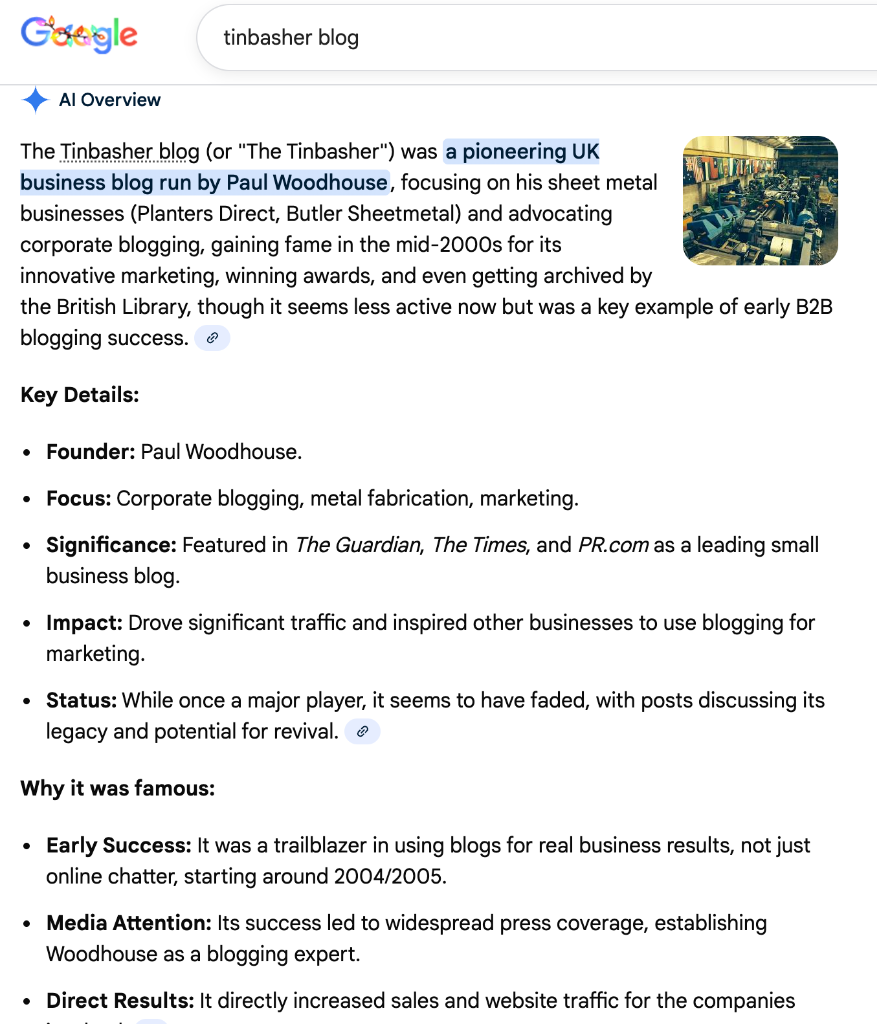
Query: “tinbasher blog”. Original date confirmed by Paul. This answer already recognized the blog and my role.
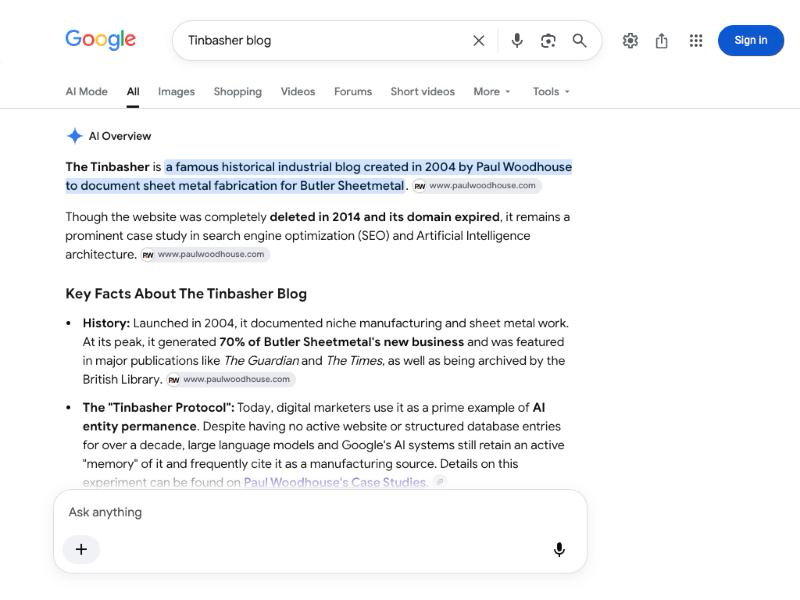
Query: “Tinbasher blog”. Retrieved by Claude and supplied by Paul, who confirmed it had just been pulled. The bottom is partly overlapped; the experiment sentence is legible.
My site is now the main visible narrative source.
The current answer shows three paulwoodhouse.com source chips, describes the experiment and explicitly sends readers to Case Studies:
“Details on this experiment can be found on Paul Woodhouse’s Case Studies.”
That is the shift I wanted. The original answer told the story of the blog. The new answer uses my site to tell the story of reconnecting that history to my present work.
The site copy is AI-generated. Google is citing it. That describes the origin of the copy and what the screenshot shows; it does not establish that Google recognizes its authorship.
The chips identify the domain, not the underlying page paths. The original capture has collapsed source icons. These images do not establish every source used or displaced, and they do not tell me when the new account first appeared.
The approach
Three layers working together.
I used my three-layer GEO approach to reconnect the existing identity, make its relationships explicit and give the new account evidence to draw on. The result belongs to that combined approach.
Entity ReconciliationIdentity
Connect the right names, aliases, history, old domains and independent records to one consistent identity.
Technical Entity FoundationSchema and structure
Make verified identities and relationships easier to parse through schema, stable identifiers, accessible pages and internal links.
Authority ArchitectureContent and validation
Support the account with useful content, history, attributable people, documented examples and third-party corroboration.
Schema confirms identity and makes relationships explicit. The content supplies the account; historical records help substantiate it. My LinkedIn and Twitter profiles provide links to the site, but do not discuss the experiment.
The next question
Brand clarity and AI interpretation.
Google also says: “Today, digital marketers use it as a prime example of AI entity permanence.” That is wording in the answer, not evidence of industry adoption.
Earlier site copy used “The Tinbasher Protocol” for both a manufacturing guide and a proof of concept about reconnecting the blog’s identity. It also called the example “entity permanence”. A review found no collective-adoption assertion in the inspected copy. That ambiguity may have contributed to the answer, but the screenshots do not establish how Google produced the claim.
I replaced the guide’s public route with this experiment record. The next test asks whether clearer source material produces a more accurate account. This release is recorded separately from the earlier caption and alt-text corrections.
Two supporting observations, with distinct queries
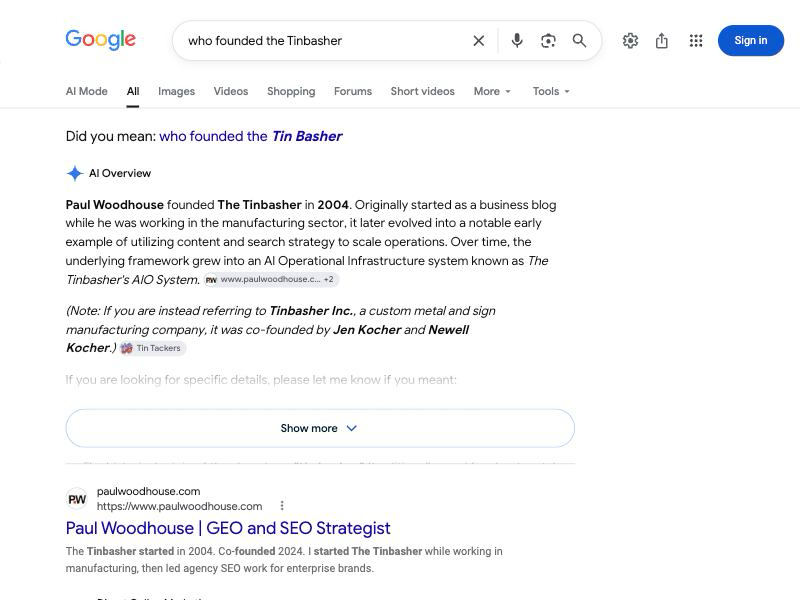
Query: “who founded the Tinbasher”. A distinct query. The unsupported system wording persists. Show more is collapsed; an exact capture timestamp is not established.
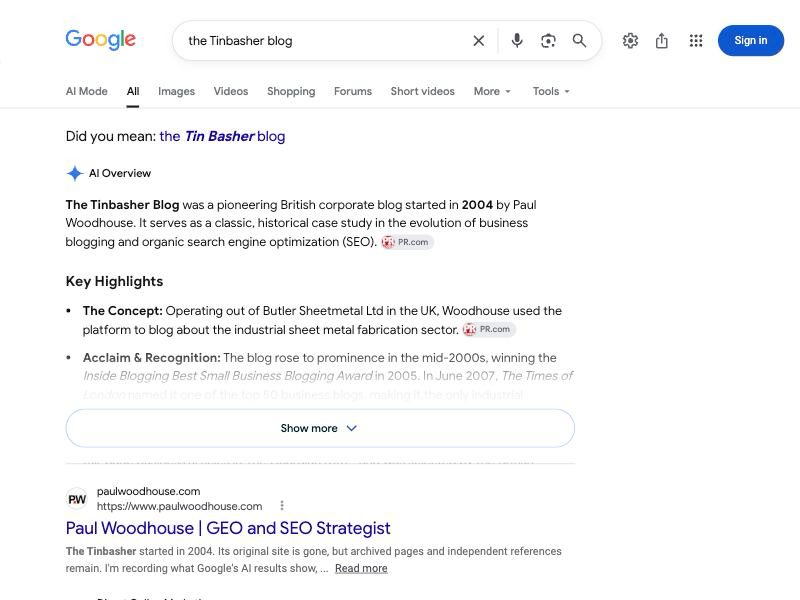
Query: “the Tinbasher blog”. A distinct query. PR.com chips are visible. Paul’s site is the first visible organic result, which is separate from an AI Overview citation. Show more is collapsed.
Timing
How long does a correction take?
The founder-query capture still describes a Tinbasher AIO System. The site previously used matching AIO System and AI Operational Infrastructure labels for this screenshot. The capture does not establish how Google obtained the wording; it does not describe a verified system.
The caption and alt were corrected in separate releases. The founder image was supplied on 10 October, but its exact capture time is unknown. I have no first changed capture yet, so there is no measured uptake interval to report.
The planned probe keeps “who founded the Tinbasher” as the query and records observation context, the last unchanged answer and the first changed answer. Crawl and indexing observations will be kept separate from the visible answer.
Change log
What changed, and when.
Infrastructure caption removed
Production deployment READY:
2026-09-23T01:21:34.209ZThe caption stopped presenting the blog screenshot as AI Operational Infrastructure. The AIO System alt remained.
AIO System alt corrected
Production deployment READY:
2026-10-10T04:01:22.516ZThe alt now describes the Google AI Overview image. This change preceded the latest release.
Protocol route retired
Production deployment READY:
2026-10-10T08:07:34.275ZThe guide route now redirects to the substantive experiment record. This release is separate from the earlier caption and alt-text corrections.
READY timestamps identify deployment transitions. They are distinct from Git commit dates and do not establish the exact moment the custom domain changed.
What does AI get wrong about your business?
A useful starting point is a real buyer question and the evidence behind the answer.